
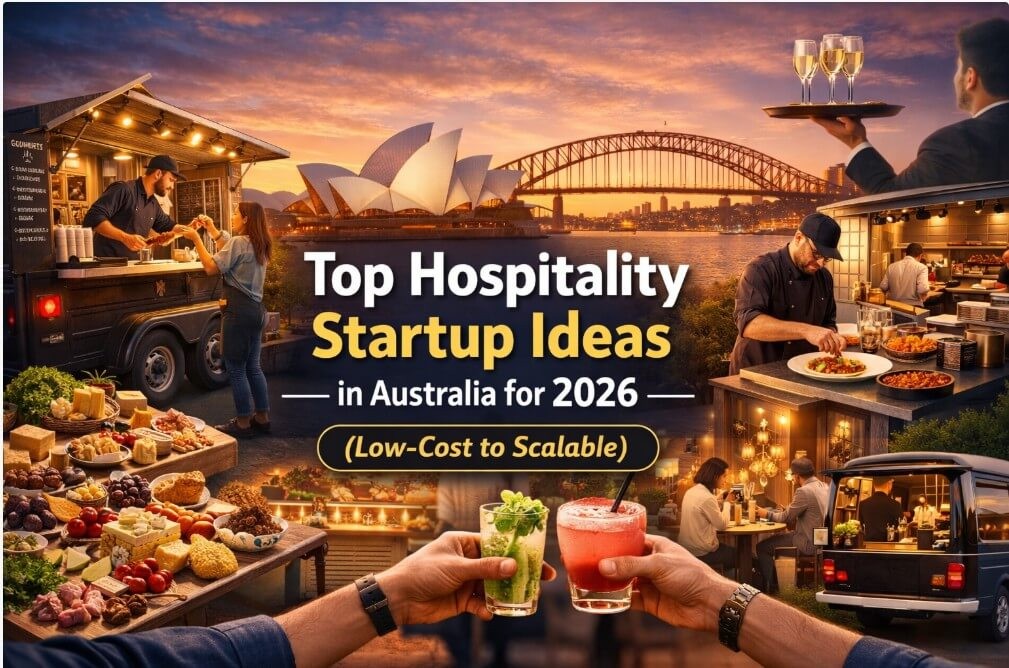
Thinking about launching a hospitality business in 2026? You’re not alone, and that’s exactly why this is the perfect time to get your idea right and execute it smarter than ever.
Australia’s hospitality industry is evolving rapidly. High rents, staffing shortages, and shifting customer expectations mean that traditional restaurant models are no longer the safest bet. The best opportunities today lie in lean, focused, and scalable concepts that meet real customer demand without heavy upfront risk.
If you’re a hospitality founder in 2026, your job is simple: validate fast, launch lean, and avoid expensive mistakes. Use this page to pick one idea, test demand within 7 days, and move forward with confidence.
This guide highlights the top hospitality startup ideas in Australia for 2026, with practical advice on how to validate your concept, make your first hires, and launch smart.
Hospitality isn’t disappearing — it’s transforming. For hospitality founders, this transformation means choosing business models that reduce risk, validate demand early, and scale without heavy fixed costs.
Here’s what’s shaping new opportunities:
Customers want authentic, local experiences rather than generic chains
Smaller, specialised concepts outperform bloated menus
Delivery, pop-ups, and mobile formats cut risks and costs
Technology makes launching and operating easier even with small teams
If you’re a hospitality founder who wants to avoid expensive mistakes and validate demand early, start with this foundational guide: How to Start a Hospitality Business in Australia – 2026 Guide.
Choose your startup type
Low-cost & fast cash
• Pop-ups
• Food trucks
• Mobile coffee vans
Delivery-first
• Ghost kitchens
• Dessert delivery brands
Prepaid & booked in advance
• Catering
• Mobile bar carts
Experience-led premium
• Cultural dining
• Co-working cafés
Health trend
• Kombucha & wellness bars
Here are the top hospitality startup concepts that combine real demand, low entry cost, and scalability.
Pop-up hospitality concepts are one of the smartest ways to test a business idea without committing to long-term rent.
Why this works:
No permanent lease
Quick feedback from real customers
Ideal for validating menus and locations
Pop-ups let you fail cheap and pivot fast if needed.
Best suited for:
• First-time hospitality founders
• Menu-driven concepts
• Founders testing location demand
Fast validation method
• Weekend pop-ups
• Limited-time menus
• Social pre-orders
Explore step-by-step launching guidance in our startup article on How to Start a Hospitality Business in Australia – 2026 Guide.
Food trucks remain one of the strongest hospitality startup ideas for aspiring food entrepreneurs.
Why this works:
Lower cost than brick-and-mortar
Flexibility to serve events, markets, and high-traffic zones
Great for chefs wanting to refine menus
Food trucks are a reliable way to build repeat customers and test new offerings.
Typical starting cost range:
• $30,000 – $80,000 depending on fit-out
Founder advantage:
• Mobility reduces location risk
• Faster break-even than fixed venue
Ghost kitchens are delivery-first brands operating from commercial kitchen spaces without a storefront.
Why this works:
Minimal rent and fit-out costs
Simplified operations
Strong scalability across suburbs or cities
This model is ideal for founders focusing on delivery platforms like Uber Eats or DoorDash.
Once demand is confirmed, you can build scale through digital marketing and streamlined operations to reduce overhead.
Best suited for:
• Delivery-first founders
• Lean teams
• Digital marketing-led brands
Key risk to manage:
• Platform dependency
• Margin control
Wellness beverages are trending as consumers increasingly prioritise health.
Focus on:
Kombucha
Functional beverages
Adaptogen-based crafts
These businesses often have:
Higher margins
Simple prep workflows
Strong visual appeal on social media
Consumers are paying for experience as much as food.
Culturally-driven offerings have loyal communities behind them.
Examples:
Authentic regional brunches
Limited-run dinner experiences
Food festivals under your own brand
Such concepts succeed when paired with compelling stories and community engagement.
Mobile coffee vans are resilient, low-risk hospitality startups with predictable demand.
Why this works:
Great in office precincts, schools, and events
Minimal staffing needs
Strong cash flow early
Many founders use coffee vans as stepping stones toward larger venues.
Event catering remains consistently profitable because it’s booked in advance and often pre-paid.
Why this works:
Large orders
High per-event revenue
No storefront overhead
Niche specialties (e.g. grazing tables or themed menus) help you stand out.
These focus on one dessert type — and do it very well.
Examples:
Donuts
Brownies
Ice cream or soft sweets
Why this works:
Strong social appeal
Easy to market visually
Fits well with delivery and pop-up formats
This format is especially strong with Gen Z and social-media-driven customers.
Whether at weddings, corporate events, or private parties, mobile bar services are high-margin and easy to deploy.
Why this works:
Mobile setup = low overhead
High perceived value
Works with cocktails and non-alcoholic versions
This type of hospitality business thrives with excellent branding.
Blending workspace with hospitality is a growing trend in suburbs and CBDs.
Why this works:
Built-in audience (remote workers)
Longer customer dwell time
Multiple revenue streams
Provide stable Wi-Fi, comfortable seating, and flexible bookings for long stays.
Choosing an idea is not about passion alone — it’s about proof. From a hospitality founder’s perspective, the right concept balances demand, capital efficiency, and long-term operational sustainability.
Here are key questions to guide you:
Has the idea been validated?
Try surveys, limited pop-ups, or pre-orders before major investment. Learn more about validation in our guide: How to Validate Your Hospitality Startup Idea (Before Spending Big)
Do the numbers work?
Know your costs, margins, and expected returns before signing leases or buying equipment.
Is this scalable?
Can this idea grow beyond one location?
Does this fit your lifestyle?
Hospitality is demanding — choose a model you can sustain.
Are you compliant?
Ensure you understand council rules, food safety, and licences. A quick run-through here: Licenses & Legal Requirements for Hospitality Startups (Australia 2026)
For hospitality founders, the goal is not to choose the most exciting idea — it’s to choose the one that survives its first 12 months with minimal stress and maximum learning.
For hospitality founders, one of the biggest early challenges is staffing. Hiring too early kills cash flow, but hiring poorly kills quality.
Here’s how to stay lean:
Hire multi-skilled team members
Use casual staff during peak times
Delay full-time hires until revenue is steady
Use mentorship or advisory support early
Need help sourcing staff who understand startup culture? Check:
👉 Where to Find Staff for Your Hospitality Startup in 2026 (Without Over-Hiring)
Helpful tools can reduce mistakes and save time:
POS & Ordering: Square, Lightspeed, Kounta
Menu & Design: Canva, Instagram, Linktree
Booking Systems: OpenTable, ResDiary
Hiring & Startup Support: Venture Uplift
If you want inspiration and real examples of hospitality founders who went from idea to growth fast in 2026, check this collection of success stories:
👉 Real Hospitality Success Stories: How Entrepreneurs Are Growing Faster in 2026
What is the best hospitality startup idea in Australia?
The best hospitality startup idea depends on your budget, skills, and location. In 2026, food trucks, pop-ups, ghost kitchens, and mobile coffee vans are among the strongest entry-level models.
What is the cheapest hospitality business to start?
Low-cost options include pop-up food stalls, mobile beverage vans, and delivery-focused concepts run from shared kitchens.
Are hospitality startups profitable?
Yes — if you launch with lean operations, validate early, and manage staffing and costs effectively.
How much money is needed to start?
Some hospitality businesses can begin under $30,000–$50,000 using pop-ups or mobile vans, while traditional venues require more capital.
How do I validate my idea before launch?
Use surveys, soft launches, pre-orders, and small-scale pilots to test demand.
The best hospitality startup ideas in Australia in 2026 are lean, demand-driven, and scalable. Whether you’re launching a food truck, ghost kitchen, event catering service, or co-working café, success comes from validating early, hiring smart, and launching with focused systems.
👉 Ready to build your hospitality team or test your idea?
Post on Venture Uplift to connect with experienced chefs, baristas, and hospitality experts.